
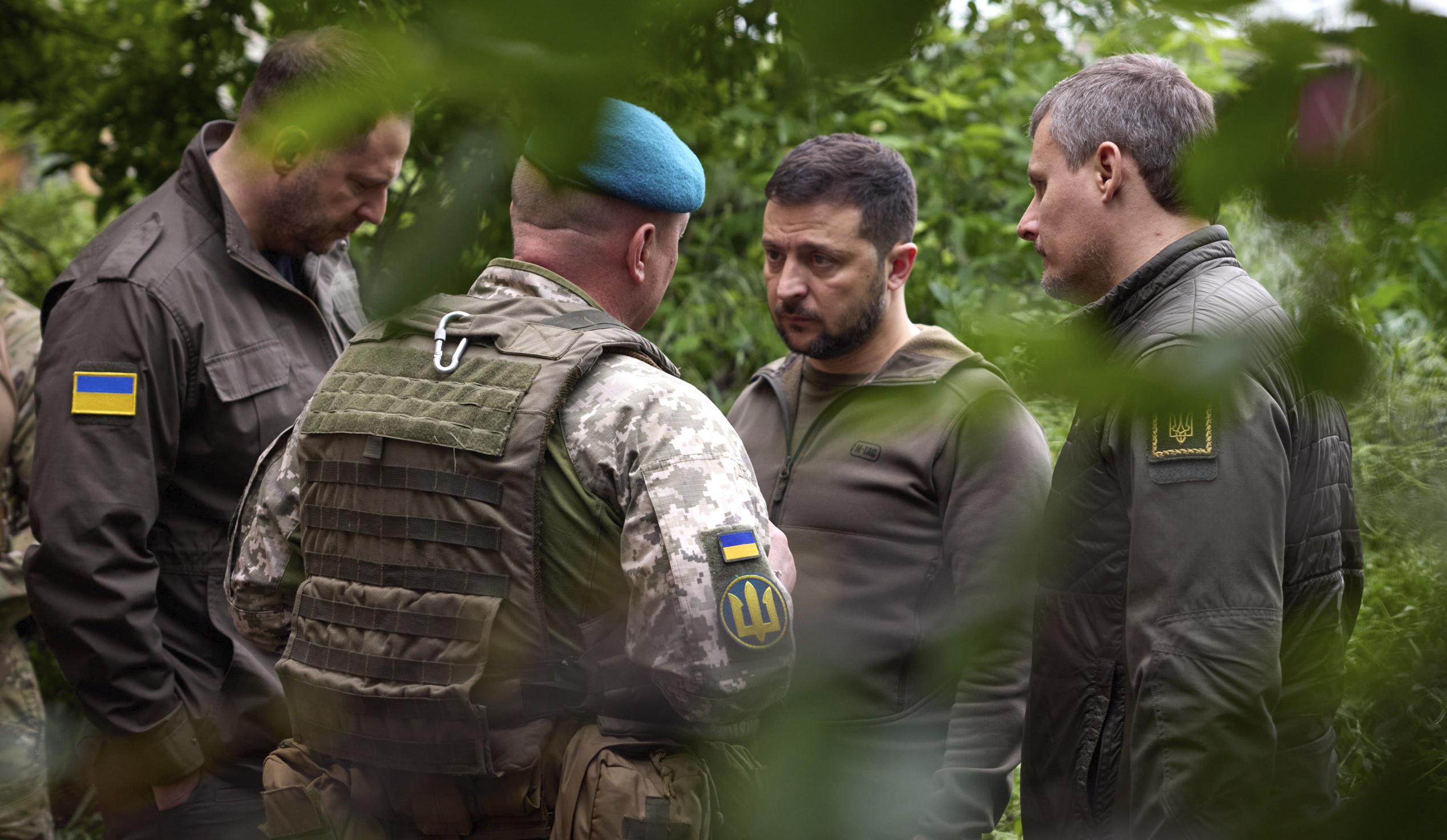
Ukrainian leader Volodymyr Zelensky has emphasized that Ukraine will not agree to territorial compromises in the Donbas area, a position he reinforced as Russian military forces began new attacks. Although there are reports of Russian troops making gains in the eastern region of the nation, Zelensky strongly affirmed that relinquishing the Donbas would not achieve lasting peace. He insisted that such an action would merely offer Russia a “launching pad” for future offenses, putting other significant cities such as Dnipro, Zaporizhzhia, and Kharkiv at risk of aggression. This steadfast stance comes amid ongoing diplomatic endeavors to resolve the persistent conflict, with some proposing that a “land exchange” could be included in a peace agreement.
The military scenario in the Donbas remains complex and ever-changing. Russian troops have recently broken through a small section north of Pokrovsk, advancing significantly and endangering an essential supply line. This renewed offensive by Moscow’s troops, employing infiltration tactics with small infantry units, is seen by military experts as a major hurdle for Ukraine’s stretched and undersupplied forces. Ukrainian authorities have admitted the breakthrough but have emphasized that reinforcements are being sent to manage the situation and that some infiltrating Russian units have been eliminated. The strategic value of the Donbas region, with its reinforced defensive positions and control of crucial areas, makes it a vital battlefield.
President Zelensky’s assertive remarks about not giving up land also serve as a direct reaction to a suggested peace agreement being considered globally. With a meeting planned between U.S. President Donald Trump and Russian President Vladimir Putin in Alaska, there have been indications that a truce could be reached if Ukraine abandoned control over certain areas in the Donetsk and Luhansk regions. Zelensky has voiced his doubts regarding these discussions, especially since Ukraine was not included in the initial negotiations. He stressed that any peace deal must incorporate strong security assurances for Ukraine and cannot be resolved without its active involvement. The Ukrainian leader views the idea of territorial concessions as a risky precedent that would not ensure an end to the conflict.
The ongoing conflict in the Donbas region is a complex mix of military strategy, political maneuvering, and historical grievances. Russia’s desire to control the entire Donbas, which it claims as its own, is a central objective of its invasion. For Ukraine, the region represents not just territory but a symbol of its sovereignty and independence. Ceding the land would be seen as a betrayal of the soldiers who have fought and died to defend it, and a violation of the country’s constitution. This deep-seated commitment to territorial integrity makes any talk of a “land swap” a non-starter for Kyiv. The political and social pressure on Zelensky to hold the line is immense, as his government’s legitimacy rests on its ability to protect the nation’s borders and its people.
The recent Russian advances, while tactically significant, should also be viewed within the context of the broader conflict. Military analysts note that Russia’s strategy is to create a narrative of success in the Donbas to influence international opinion and pressure Ukraine into making concessions. By demonstrating battlefield gains, Moscow hopes to convince the world that its victory in the region is inevitable. However, these advances come at a heavy cost, with Russian forces reportedly suffering high casualties in their attempts to breach Ukrainian defensive lines. The resilience of Ukrainian forces, despite being outmanned and outgunned in some areas, remains a crucial factor in the conflict. The war is not just a test of military might but also of national will and international support.
The international community’s role in this conflict is also a key factor. While the United States and its European allies have provided significant military and financial support to Ukraine, the looming talks between Trump and Putin have created a sense of unease in Kyiv and European capitals. The fear is that a deal might be struck that prioritizes a quick end to the conflict over Ukraine’s long-term security and territorial integrity. European leaders have already appealed to Trump to involve Ukraine in any peace talks and to not be swayed by Putin’s demands for territorial concessions. The unity of the international coalition supporting Ukraine is a critical deterrent to further Russian aggression, and any sign of a fracture could embolden the Kremlin.
In the end, President Zelensky’s unyielding position on the Donbas signifies the Ukrainian people’s commitment to defending their nation’s future. The conflict has been a harsh and expensive ordeal, yet it has also nurtured a strong sense of national pride and determination. The notion of exchanging territory for a temporary truce is regarded as a futile endeavor, as it would merely delay the unavoidable and place Ukraine in a weaker stance. For Kyiv, genuine and enduring peace can only be realized by reinstating Ukraine’s complete territorial sovereignty and offering solid security assurances to prevent future incursions. Thus, the struggle for the Donbas is not only a military operation; it embodies a battle for the heart and future of the nation.
The events unfolding in the Donbas region serve as a stark reminder of the enormous human toll of this conflict and the tough decisions that Ukraine’s leadership must make. The pressure from both the battlefield and the diplomatic arena is substantial, yet President Zelensky has remained steadfast in his principles. His message is unequivocal: Ukraine will not relinquish its territory. This resolute stance, though politically and militarily challenging, is the cornerstone of the country’s resistance and its aspiration for a sovereign and secure future. The international community, particularly those attending the forthcoming summit, must consider this position as they discuss a way forward. The fate of the Donbas, and indeed of Ukraine, is in the balance.
