

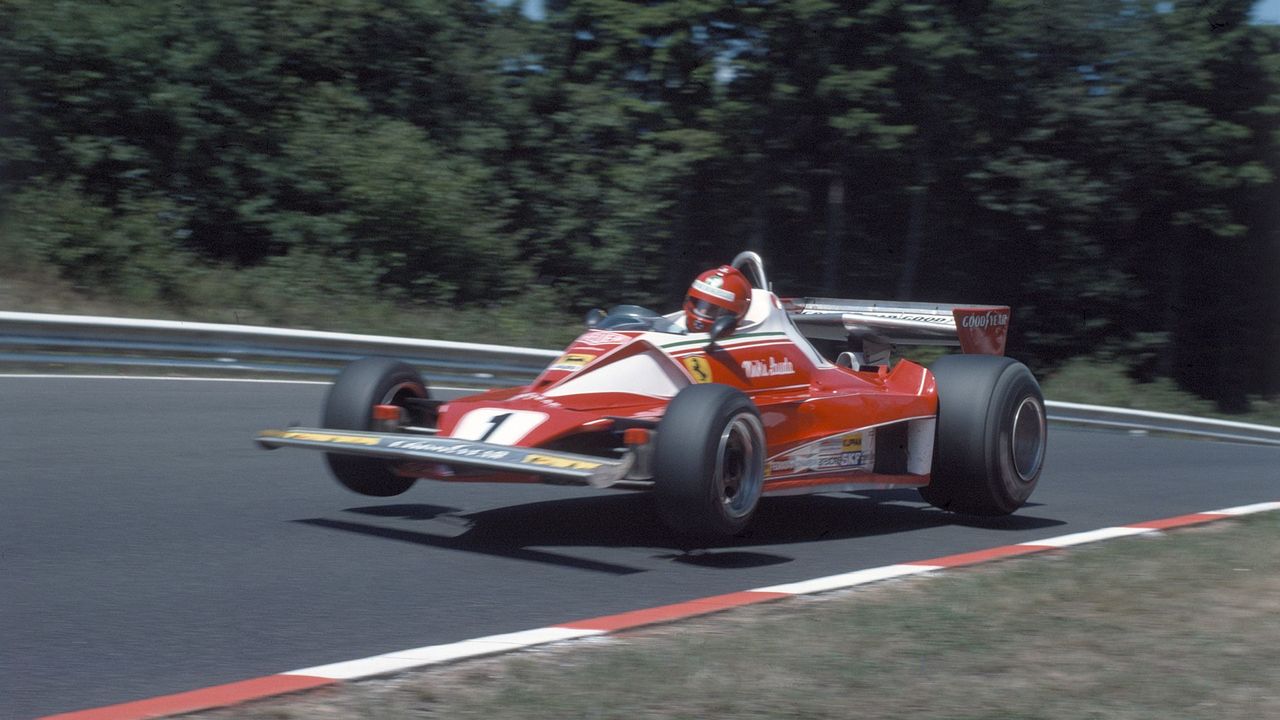
Niki Lauda’s name is etched into the history of Formula 1 not just because of his talent behind the wheel, but because of the resilience he demonstrated following one of the sport’s most harrowing accidents. His survival of the 1976 Nürburgring crash was not just a testament to medical intervention or luck—it was the product of unyielding mental determination. For Lauda, surviving wasn’t about bravado or physical strength, but rather a fierce internal struggle, one where, as he famously said, “you just fight with your brain.”
By the time Lauda arrived at the infamous Nürburgring circuit in August 1976, he was already World Champion and widely respected for his analytical approach to racing. Unlike many of his contemporaries, he brought a meticulous, almost scientific mindset to the track, studying data and perfecting strategy. But that same race would nearly end his life—and forever redefine the limits of human resilience.
The Nürburgring Nordschleife, commonly called “The Green Hell,” stands out as one of the riskiest tracks in the history of motorsports. With its narrow, winding layout, it intimidated even the most skilled drivers. On August 1, during the second circuit of the German Grand Prix, Lauda’s Ferrari lost control at high velocity, hit a slope, and caught fire. Confined in the debris for almost a minute, Lauda endured extensive burns to his face and body, and his lungs suffered significant harm from the harmful smoke.
Fellow drivers Arturo Merzario, Guy Edwards, Brett Lunger, and Harald Ertl pulled him from the burning car, saving his life. But once in the hospital, Lauda’s condition worsened. He fell into a coma, and his chances of survival seemed slim. Skin grafts, blood transfusions, and lung treatments followed. Yet amid the physical trauma, it was his mental discipline that would ultimately become his strongest weapon.
La forma en la que Lauda enfrentó su recuperación fue tan meticulosa como su táctica en las carreras. Se concentró en objetivos a corto plazo, eliminando el miedo y el dolor con la misma fuerza mental que empleaba en la pista. Su lucha fue personal e interna, la cual describió posteriormente como un proceso en el que la determinación superó al sufrimiento. Mientras los médicos trabajaban para estabilizar su estado, Lauda se preparaba para un regreso que pocos consideraban viable.
Incredibly, just six weeks after his near-death experience, Lauda was back in a Ferrari cockpit at the Italian Grand Prix in Monza. Still bearing the raw scars of his accident, he defied every expectation by finishing fourth in the race. The act was more than a comeback; it was a declaration of strength and intent. His rivals, his team, and even his critics were stunned—not just by his speed, but by his decision to return at all.
La resiliencia mental de Lauda se manifestó más allá de su recuperación física. El punto culminante de la temporada de 1976 fue un intenso enfrentamiento con el piloto británico James Hunt, un feroz competidor y totalmente opuesto a Lauda en cuanto a personalidad. El marcado contraste entre el pragmatismo disciplinado de Lauda y la espontaneidad extravagante de Hunt resultó fascinante, convirtiendo su rivalidad en algo legendario.
The final race of the season took place under treacherous weather conditions at Fuji Speedway in Japan. Facing a rain-soaked track and the risk of further injury, Lauda withdrew after just two laps, stating that the risk was unjustifiable. Hunt went on to win the championship by a single point. Though Lauda’s decision cost him the title, it underscored his new outlook on life: one shaped by near-death and driven by clear priorities.
What emerged from Lauda’s crash wasn’t just a story of comeback, but a narrative of introspection and evolution. He transformed as a man and a racer, becoming more than just a driver who survived—he became a symbol of resilience, courage, and calculated resolve. His career, which continued with another two world titles in 1977 and 1984, was shaped as much by that fiery crash as by the championships he won.
Beyond his racing career, Lauda’s influence kept expanding. He entered the aviation industry by establishing Lauda Air and later took on significant responsibilities in F1 management, providing technical expertise and direction. His commentary and advisory contributions significantly impacted the sport even after his retirement from racing.
Lauda’s story has been recounted in documentaries, interviews, and the acclaimed 2013 film Rush, which dramatized the 1976 season and his rivalry with Hunt. But no film or article can fully capture what Lauda endured—and how he chose to confront it.
Surviving an accident of such scale was extraordinary in and of itself. However, what truly set Lauda apart was the mental focus he maintained during his recovery and beyond. While others were astounded by the physical consequences—his burned skin, his injured lungs—Lauda was concentrated on future steps. The discipline that previously aided him in reducing lap times now supported him in taking back control of his life.
For Lauda, survival was never about heroism in the conventional sense. He didn’t see himself as a victim or a miracle. He saw the process as one of decisions—made calmly, rationally, and with purpose. Even his famously blunt remark about surviving—“you just fight with your brain”—reflects this understated, pragmatic worldview. It wasn’t about drama or defiance. It was about control.
Niki Lauda’s story is one of the most powerful examples in sport of the mind’s ability to guide the body through trauma. His career wasn’t defined by a crash, but by how he responded to it. In doing so, he left behind more than trophies and headlines. He left a model of resilience rooted not in adrenaline, but in discipline, clarity, and relentless mental focus.
In the fast-paced and risky realm of Formula 1, where bravery is often timed in fractions of a second and safety can depend on a curve, Niki Lauda showed a different sort of courage—the silent kind, cultivated from the inside.
