
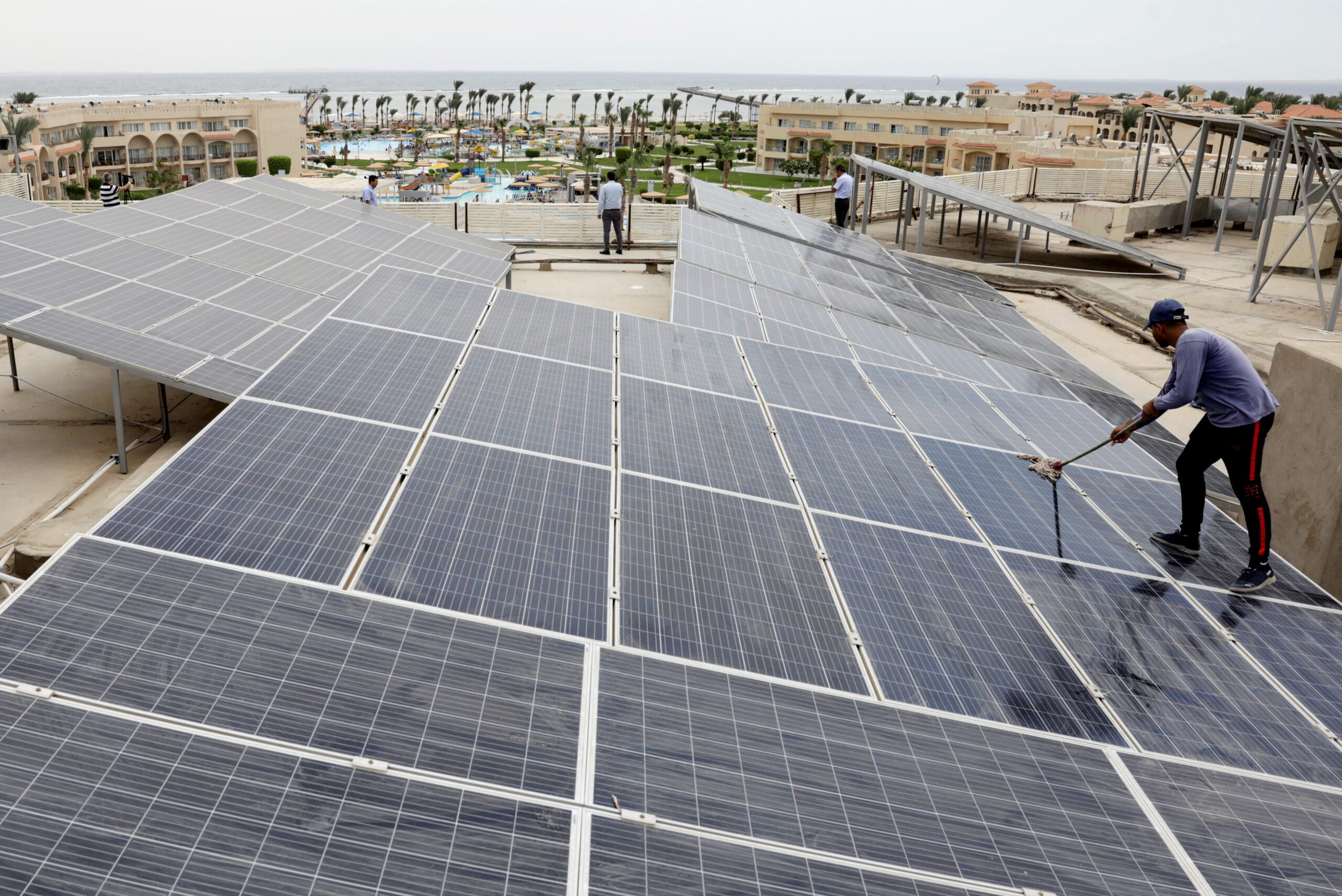
Egypt has initiated a significant renewable energy project, representing an important move towards decreasing dependency on fossil fuels and tackling persistent power shortages. The nation has begun the development of its inaugural large-scale hybrid solar and battery storage plant, situated in Nagaa Hammadi, a region recognized for its plentiful sunshine. This pioneering endeavor, named Obelisk, will integrate solar power with battery storage, enhancing the reliability and sustainability of energy.
The $590 million undertaking is being developed by Scatec, a renewable energy firm based in Norway that focuses on advancing clean energy solutions in emerging markets. Obelisk is set to deliver 1.1 gigawatts (GW) of solar electricity paired with 200 megawatt-hours (MWh) of battery storage, providing a dependable energy supply even when the sun isn’t shining.
Egypt, historically reliant on natural gas to generate electricity—with roughly 75% sourced from this energy type—has been grappling with an escalating power shortage in recent times. The country has seen a drop in domestic gas output, while climbing global rates have compelled it to purchase fuel at steep prices. The ensuing strain on Egypt’s power grid has led to regular outages, leading to urgent demands for immediate resolutions.
Scatec is well-acquainted with Egypt’s energy sector, having carried out four renewable energy initiatives in the nation before. However, Obelisk is distinguished by its magnitude and technological blend. As Terje Pilskog, the CEO of Scatec, observes, energy security extends beyond just generating power—it involves being free from unpredictable fuel markets. “Renewables provide stability,” Pilskog clarifies. “You aren’t tied to fuel imports or sudden price hikes.”
To tackle its expanding energy issues, Egypt has pledged to boost the proportion of renewables in its energy composition. The authorities aim to elevate the present 13% share of renewable energy to 42% by 2030. Although these goals are bold, they are deemed essential for decreasing dependence on fossil fuels, particularly as production from significant sites like the Zohr gas field declines.
As a component of this shift, Egypt launched a tender around mid-2024 to acquire almost two million tons of fuel oil to handle the high demand during the summer peak, which puts pressure on the electricity system as temperatures frequently surpass 40°C (104°F) in the southern areas. Prime Minister Mostafa Madbouly has encouraged people to save energy to assist in reducing more power outages.
However, as Egypt examines new local gas resources, it is also progressively focusing on its geographical strengths. The southern area of the nation is located in what specialists refer to as the “Magic Solar Belt,” an area with some of the highest solar radiation levels worldwide. Based on the Global Solar Atlas, Egypt is ranked fourth internationally for photovoltaic (PV) potential. This optimal spot makes the Obelisk project particularly encouraging.
Karim Elgendy, the executive director of the think tank Carboun Institute, which concentrates on the Middle East and North Africa, emphasizes the both economic and strategic importance of Obelisk. “This goes beyond being merely an environmental effort,” he states. “It represents an investment motivated by economic considerations. Such projects have the potential to showcase the feasibility of solar-plus-storage solutions in emerging nations.”
Traditionally, the main drawback of solar energy has been its inability to generate power continuously—it only functions when the sun is shining. Nevertheless, the decreasing expenses of battery storage are transforming this scenario. Since 2010, the cost of large-scale battery storage initiatives has decreased by 89%, partly due to increased production in countries such as China. Consequently, hybrid facilities that integrate solar energy with storage have become much more viable.
In fact, the Global Solar Council projects that by 2027, solar-plus-battery configurations will offer the lowest-cost electricity generation globally. However, despite this potential, Africa remains underrepresented in global battery storage deployment. Of the estimated 363 gigawatt hours (GWh) of global storage capacity in 2024, Africa accounts for just 1.6 GWh.
This disparity highlights a broader challenge—financing. Despite the fact that renewable energy technologies are becoming more economically viable, securing funding for large-scale endeavors in emerging markets remains a significant obstacle. The “risk premium” frequently associated with investments in developing regions increases project costs and complicates their initiation. In 2024, Africa accounted for just 3% of energy investments worldwide, despite its vast renewable potential.
To overcome these barriers, the Obelisk project is supported by several international financial institutions. The European Bank for Reconstruction and Development, the African Development Bank, and British International Investment have together pledged nearly $480 million to fund the initiative. This backing is essential to moving the project forward and signals growing international confidence in Africa’s renewable future.
The development of Obelisk is planned in stages, with 561 MW of solar energy and the complete battery storage facility anticipated to be functional by the middle of 2026. The project aims to reach its total capacity of 1.1 GW by the closing months of that year. Once finished, it will rank among the most extensive hybrid renewable energy systems on the continent.
Egypt’s shift towards solar energy aligns with a wider movement in Africa, where renewable energy is becoming a vital force for economic growth. Despite the continent having 60% of the world’s prime land for solar power, only 3% of Africa’s energy originated from solar in 2023. However, progress is being made. By 2024, South Africa and Egypt represented 75% of new solar developments in Africa, and at least 18 nations are anticipated to undertake projects surpassing 100 MW in 2025.
Meanwhile, Egypt has been expanding its infrastructure footprint in other ways. High-profile projects such as the 2,000-kilometer high-speed rail system—linking 60 cities across the country—and expansions to the Suez Canal aim to modernize transportation and trade. These developments reflect a broader strategy to position Egypt as a regional hub for energy, logistics, and economic growth.
Nevertheless, energy remains a critical issue. The country’s dependency on fossil fuels has made it vulnerable to external shocks, and rising temperatures only exacerbate power demands. But projects like Obelisk offer a pathway toward energy resilience and independence.
Beyond its practical benefits, Obelisk represents a shift in how nations in the Global South are approaching energy policy—not just as a climate issue, but as a matter of economic security, investment attractiveness, and long-term growth.
Egypt is taking its first steps in the solar energy sector, yet the message is unmistakable: by combining appropriate resources, advanced technology, and global assistance, renewable energy has the potential to significantly transform the region’s energy scene.
As construction moves forward, the Obelisk project may well become a model not only for Egypt, but for other nations facing similar energy and economic challenges—highlighting the importance of sustainable infrastructure as both a solution and a strategic opportunity.
