

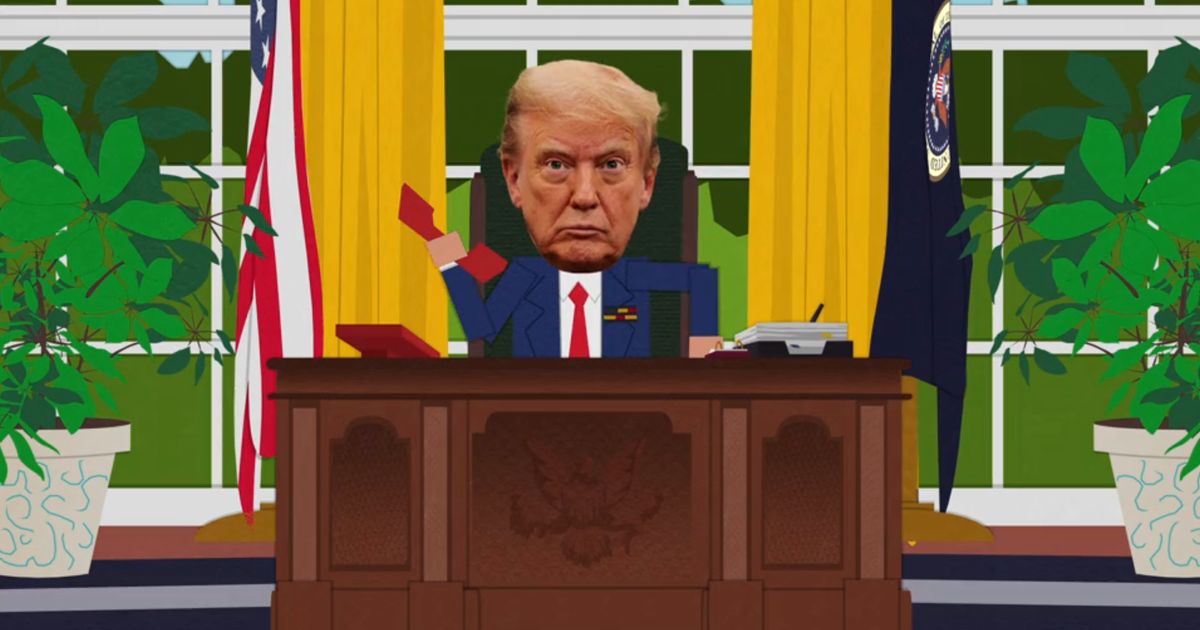
The creative minds behind South Park, Trey Parker and Matt Stone, have once again stirred attention with a characteristically irreverent response involving former U.S. President Donald Trump. Known for their sharp satire and fearless commentary on political and cultural figures, Parker and Stone used their platform to deliver what appeared to be a tongue-in-cheek “apology” that, true to form, was layered with irony rather than contrition.
Over the years, South Park has built a reputation for tackling controversial subjects head-on, often walking the line between comedy and critique. The show’s long-standing approach has been to highlight the absurdities of real-world events through exaggerated humor and biting commentary. Their latest interaction with the Trump narrative continues this tradition, offering audiences another example of how satire can be both entertaining and thought-provoking.
The so-called apology came in the form of a mock statement—crafted with the same tone and style that fans of the series have come to expect. Rather than issuing a sincere expression of regret, Parker and Stone used the moment to reflect on the current media climate and public discourse, particularly surrounding figures as polarizing as Trump. The statement was framed not as a genuine retraction, but rather as a layered commentary on outrage culture, public backlash, and the complex relationship between entertainment and politics.
During the series’ progression, Donald Trump was frequently featured. The individual known as “Mr. Garrison” acted as an unmistakable satire of Trump during the 2016 elections and afterwards. The creators utilized this narrative to tackle wider issues related to leadership, populism, and societal response. Their depiction wasn’t meant to support or vilify, but to highlight the contradictions and dramatic elements inherent in today’s political realm.
In this latest occurrence, the authors’ message appeared to focus less on Trump as an individual and more on the theatrical aspect of public apologies in the current media environment. The expressions employed resembled those of corporate or celebrity apologies—meticulously formulated, openly distributed, and frequently analyzed more for their delivery style rather than their substance. Parker and Stone utilized this well-known format to convey a message that fundamentally criticized the trend of performative apologies that have infiltrated both political and entertainment sectors.
By presenting their message as an “apology,” the South Park creators introduced an additional aspect to their satire: the implication that in modern culture, even humor needs to proceed with caution. The irony was clear to viewers, many of whom noticed the intentional imitation of public relations language and the deeper discussion on censorship, freedom of expression, and the limits of satire.
Parker and Stone have consistently resisted efforts to censor their content or soften their tone, even in the face of significant backlash. Their creative philosophy emphasizes pushing the envelope and confronting difficult issues through humor, even when that humor makes viewers uncomfortable. It is this unapologetic stance that has earned them both praise and criticism, and their latest gesture is another reminder of their unwillingness to conform to external expectations.
The creators’ response also served to reaffirm their long-held belief that comedy plays a vital role in societal critique. In their view, laughter can challenge authority, provoke thought, and expose hypocrisy. By drawing attention to the mechanisms of modern discourse—especially the tendency to demand retractions or apologies for controversial content—they encourage audiences to question not only what they see on screen but also how they react to it.
Esta dinámica entre South Park y su audiencia ha cambiado a lo largo de los años. Lo que comenzó como una serie animada irreverente enfocada en humor inmaduro se ha desarrollado en una plataforma para un comentario cultural agudo y sofisticado, aunque a menudo directo. La capacidad del programa para estimular el debate mientras preserva su estilo irreverente es parte de lo que lo ha mantenido relevante por más de veinte años.
In their satire of Trump and the surrounding culture, Parker and Stone prioritize uncovering the workings of persuasion, authority, and media consumption over delivering political messages. Their humor steers away from urging viewers to choose sides; instead, it encourages them to observe closely, find humor in the ridiculous, and reflect thoughtfully on the mechanisms that mold public perception.
Although some audiences might perceive the creators’ approach as objectionable or unsuitable, others regard it as an essential counterbalance to the polished stories frequently shown in traditional media. This clash of viewpoints is precisely the realm in which South Park prospers, residing at the intersection of unease and humor, where satire functions as both a form of amusement and a method of critique.
The mock apology directed at Trump is a continuation of this legacy—a performative statement meant not to reconcile but to reflect. It challenges viewers to consider not only the subject of the joke but the nature of the joke itself, the environment in which it was made, and the expectations placed upon artists in an age of heightened sensitivity.
Parker and Stone have once again demonstrated their mastery of satire, using humor to critique not only political figures but also the cultural climate in which those figures exist. Whether one agrees with their approach or not, their work remains a provocative force in modern media—one that refuses to stay silent, back down, or deliver anything other than their unfiltered perspective.
