
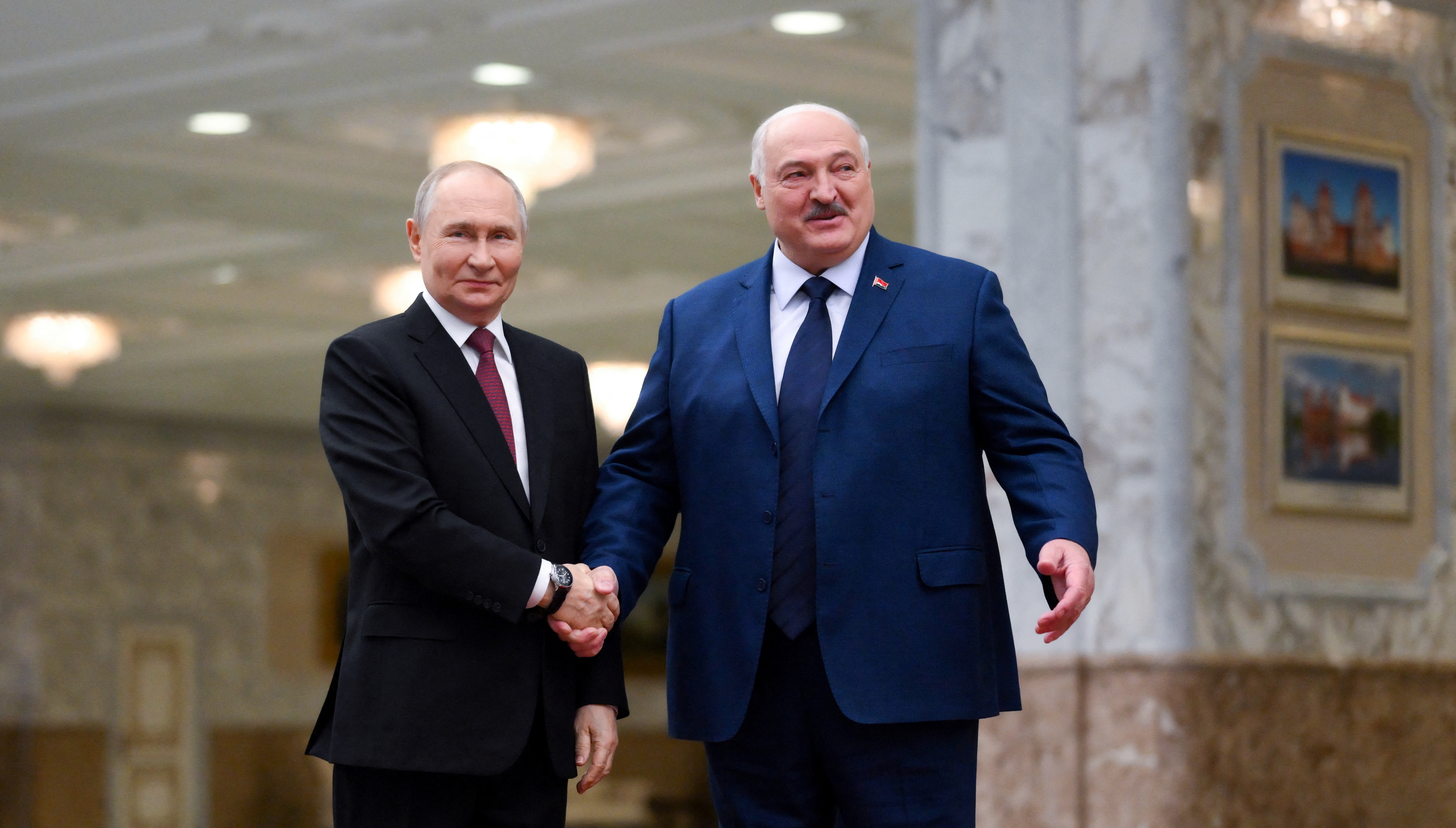
Russian President Vladimir Putin has revealed that one of the nation’s cutting-edge hypersonic missile systems is now operational and will soon be deployed to Belarus. This declaration signifies a notable advance in Russia’s continuous endeavor to enhance its strategic military strength and strengthen defense relationships with its nearest partner in the area.
According to statements made during a recent high-level meeting, the missile—described as capable of reaching extreme speeds while evading modern defense systems—has completed its final testing phases and is now considered fully operational. Deployment plans include placing the weapon within Belarusian territory, a move that could reshape the security landscape along NATO’s eastern frontier.
The decision to deploy the hypersonic missile in Belarus reflects a broader trend of increasing military coordination between Moscow and Minsk. Over the past two years, Russia and Belarus have expanded joint training operations, established shared air defense systems, and agreed on deeper logistical cooperation within their respective armed forces.
Positioning advanced weaponry on Belarusian soil is likely to be seen as a gesture of trust between the two countries, but also a strategic signal to Western powers. Belarus, which borders several NATO member states, serves as a key location for Russia’s regional military posture. By introducing cutting-edge missile systems into this zone, Moscow appears to be reinforcing its deterrent capabilities amid ongoing tensions with the West.
While official details remain limited, Russian defense officials have emphasized the missile’s speed and maneuverability as key features. Hypersonic weapons are defined by their ability to travel at speeds exceeding Mach 5, or five times the speed of sound, and are often equipped with sophisticated guidance systems that allow them to evade detection and interception.
Russia has developed multiple hypersonic platforms in recent years, including the Avangard glide vehicle, the Kinzhal air-launched missile, and the Zircon cruise missile. It remains unclear which specific system is being referred to in this latest announcement, but analysts suggest it could be a ground-based version or a modified variant tailored for regional deployment.
Such systems are considered particularly difficult for existing missile defense architectures to counter, due to their combination of high velocity, unpredictable flight paths, and low atmospheric trajectories. This capability enhances not only Russia’s first-strike potential but also its ability to target high-value installations with minimal warning.
The intended deployment of hypersonic missiles in Belarus has raised worries among NATO states, particularly those situated in Eastern Europe. Nations like Poland, Lithuania, and Latvia, which all share borders with Belarus or Russia, are expected to perceive this action as a major intensification.
NATO has earlier voiced concerns regarding Russia’s placement of sophisticated weaponry close to alliance frontiers, highlighting the risk of instability and errors in judgment. This recent situation might result in demands for improved missile defense systems in the area and increased military preparation maneuvers by allied troops.
For Belarus, allowing the deployment of Russian hypersonic missiles represents a deepening of its dependence on Moscow—not only politically, but also militarily. Following the contested 2020 presidential election and subsequent sanctions from the West, Belarusian President Alexander Lukashenko has leaned heavily on Kremlin support to maintain domestic stability. That support now extends to the country’s defense infrastructure.
Putin’s statement arises during an era of increased international unrest, especially considering the persistent war in Ukraine and sustained frictions between Russia and Western nations. Hypersonic weaponry has become more prominent in Russia’s strategic narrative, frequently emphasized as proof of the nation’s advanced technology and preparedness to face assumed foreign challenges.
By revealing that such a system is now operational and will be deployed in Belarus, the Kremlin is sending a dual message: one aimed at domestic audiences to demonstrate military strength, and another directed at foreign powers to underscore Russia’s willingness to assert its influence beyond its borders.
The announcement also coincides with various diplomatic efforts to address security concerns in Europe. However, the introduction of advanced missiles into the region may complicate those efforts, especially if viewed as a breach of existing arms control agreements or as a challenge to NATO’s collective security framework.
The international community is likely to respond with caution and concern. While there has been no immediate reaction from NATO headquarters, member states have previously called for greater transparency in Russia’s weapons development and deployment practices. Some Western officials argue that hypersonic weapons introduce a new layer of instability, as they compress decision-making timelines and reduce the effectiveness of deterrence-based strategies.
Este despliegue también podría aumentar la presión sobre los ya tensos mecanismos de control de armas. Importantes acuerdos como el Tratado de Fuerzas Nucleares de Alcance Intermedio (INF) se han desmoronado en los últimos años, y las perspectivas para futuras negociaciones de control de armas son inciertas. La incorporación de sistemas hipersónicos en Bielorrusia podría complicar más el diálogo futuro, especialmente si los países vecinos ven este movimiento como una amenaza directa.
Furthermore, the deployment of these weapons in proximity to Europe brings up concerns regarding the function of missile defense systems and if existing frameworks are adequate to tackle new threats. Countries might start to think about enhancing radar coverage, improving interception features, and modifying early warning procedures.
From a doctrinal standpoint, the deployment reflects a shift in how Russia views the role of forward-positioned weapons. While previously seen primarily as defensive tools, modern hypersonic systems also serve an offensive strategic purpose. Their presence in Belarus could enable rapid strike options against nearby targets, including infrastructure, command centers, and troop deployments.
Esta reorientación altera el equilibrio estratégico en Europa del Este, especialmente en un momento en que las tensiones regionales permanecen elevadas. Los planificadores militares en los países vecinos quizás ahora deban considerar la posibilidad de ataques hipersónicos que provengan de una mayor cercanía que nunca, lo que reduce el tiempo de reacción y complica la planificación defensiva.
Russia is still developing its strategy to incorporate these systems into its overall military framework; however, the deployment in Belarus seems to be a component of a bigger plan to expand Russia’s influence while reducing Western presence in the area.
President Putin’s confirmation that a new hypersonic missile system has entered service and will be deployed in Belarus marks a significant milestone in Russia’s military strategy. The move strengthens its alliance with Belarus, reinforces its regional presence, and introduces a powerful new variable into the European security equation.
As the global community examines the consequences, discussions about weapons regulation, deterrence, and rising tensions will become pivotal. It remains uncertain if this marks a new era of military stance or signifies a lasting change in regional defense strategies. However, at present, the deployment delivers a strong statement: Russia is determined to enhance its strategic assets, despite the ongoing increase in regional tensions.
