
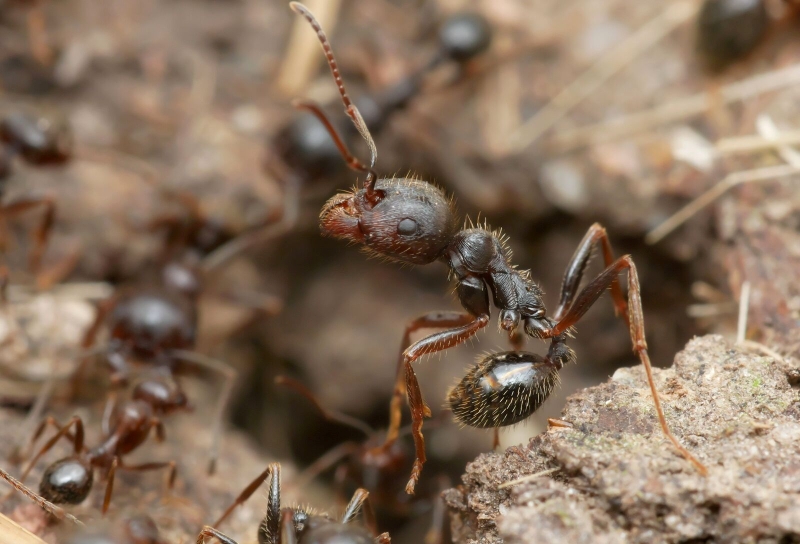
In an astonishing event in the natural world, an ant queen has been seen producing offspring from two completely distinct species. This uncommon occurrence provides fresh perspectives on genetics, evolution, and the complex social interactions within insect communities.
The findings, documented by entomologists following meticulous observation and genetic study, question the traditional perception of ant reproduction. Normally, a queen ant gives birth to her own species’ offspring, which maintains the colony’s consistency and unity. Nonetheless, in this exceptional instance, the queen was discovered to have produced offspring from two distinct species, a situation that researchers deem as remarkable and uncommon.
This phenomenon provides a unique opportunity for researchers to examine the underlying mechanisms of reproductive biology, hybridization, and genetic plasticity in insects. The implications extend beyond ants, offering a window into evolutionary processes that may occur under specific environmental or genetic conditions.
The science behind the phenomenon
Ant colonies are often celebrated for their complex social structures, with the queen serving as the reproductive heart of the colony. In most species, she produces eggs that develop into workers, soldiers, or new queens, all sharing a consistent genetic lineage. The emergence of offspring from two species disrupts this norm and prompts questions about genetic compatibility, reproductive strategies, and species boundaries.
Researchers involved in the study conducted extensive genetic testing to confirm the identities of the offspring. Their findings revealed that the queen’s eggs had somehow diverged genetically, resulting in one set producing individuals of her species while another set belonged to a closely related species. Such occurrences are exceedingly rare and suggest either previously unknown reproductive mechanisms or unusual environmental triggers that influence gene expression.
The phenomenon is not only fascinating but also scientifically significant. It challenges long-held assumptions about reproductive isolation and species fidelity in ants. Understanding how and why this dual-species reproduction occurred could illuminate broader principles of evolution, adaptation, and genetic flexibility among social insects.
Consequences for the study of evolutionary biology and genetics
Esta revelación tiene profundas consecuencias para la biología evolutiva. Usualmente, las especies se definen por su capacidad de reproducirse exitosamente dentro de un linaje específico. No obstante, el caso de una reina hormiga produciendo dos especies difumina estos límites, sugiriendo que en determinadas circunstancias, las barreras reproductivas pueden ser superadas o evitadas.
Certain researchers propose that these events may signify an uncommon type of crossbreeding or genetic irregularity, which could offer benefits for evolution in specific surroundings. For instance, the creation of progeny from two different species might enable a community to vary its labor force, adjust to fresh ecological roles, or enhance durability in the face of environmental challenges.
From a genetics standpoint, the case offers a natural experiment in gene expression and inheritance. Researchers can study how a single individual can influence the development of offspring with divergent traits and examine the molecular mechanisms that allow for such unusual reproductive outcomes. These insights could have applications beyond entomology, informing broader studies of genetic regulation, mutation, and the evolution of complex traits.
Social dynamics within the colony
The birth of two species within one colony raises questions about social cohesion and organization. Ant colonies rely on communication, chemical signaling, and cooperative behavior to function efficiently. Offspring from two distinct species could introduce new challenges for colony management, including differences in behavior, task specialization, or interaction patterns.
Entomologists observed that, despite genetic differences, the colony continued to function with remarkable stability. This observation suggests that social structures in ants may be more adaptable than previously thought, capable of accommodating genetic diversity without collapsing. It also highlights the potential role of environmental cues and chemical signaling in maintaining cohesion even when genetic lines differ.
Understanding how colonies handle such anomalies could shed light on broader principles of social evolution. In particular, it may reveal how cooperative systems can remain functional in the face of genetic variation, offering parallels to studies of social behavior in other animals, including humans.
Environmental factors and potential triggers
While the precise causes of this unusual reproductive event remain under investigation, scientists are exploring several potential triggers. Environmental stressors, such as changes in temperature, food availability, or habitat disruption, may influence gene expression in ways that promote unusual reproductive outcomes.
Additionally, interactions with closely related species in the surrounding environment could play a role. Some researchers hypothesize that exposure to chemical signals or pheromones from other species might trigger developmental pathways leading to dual-species reproduction. If confirmed, this mechanism would illustrate an intricate relationship between genetics, environment, and social behavior that is more complex than previously appreciated.
Future research will probably aim to recreate these situations in a controlled lab environment, examining the impact of environmental factors on reproductive results. Such studies may assist in determining if the occurrence is an unusual irregularity or a natural strategy that emerges in particular ecological contexts.
Broader impact on entomology and conservation
The discovery of a queen producing offspring from two species has significant implications for entomology and biodiversity research. It challenges assumptions about species boundaries, reproductive fidelity, and colony dynamics, providing new avenues for study in evolutionary biology and ecology.
In addition, the finding may influence conservation strategies. Many ant species play critical roles in ecosystems as pollinators, seed dispersers, and soil engineers. Understanding how genetic diversity and unusual reproductive patterns affect colony resilience could inform efforts to protect vulnerable species and maintain ecological balance.
Through the investigation of uncommon phenomena such as interspecies breeding, researchers acquire understanding about the resilience and intricate nature of social insects. This information might aid in predicting how species react to changes in their environment, the presence of invasive species, or the segmentation of habitats, thereby improving efforts in conservation and environmental management.
Public fascination and educational value
Unusual discoveries like this one capture public interest and provide excellent opportunities for science education. The notion of a queen ant giving birth to two species is visually striking, easy to communicate, and naturally sparks curiosity. Educators can use this case to teach genetics, evolution, and social behavior in a way that is both engaging and memorable.
Beyond classrooms, such stories highlight the unpredictable and wondrous aspects of the natural world. They remind the public that science is full of surprises and that even well-studied organisms can reveal new mysteries. This sense of wonder is essential for cultivating a broader appreciation for research and the value of studying diverse ecosystems.
The sight of a queen ant giving birth to offspring from two separate species is a remarkable occurrence that has significance in the fields of genetics, evolution, ecology, and social behavior. It questions the traditional concepts of species limits, offers knowledge on the flexibility of social insect communities, and ignites public interest in the natural environment.
As scientists continue to investigate the genetic, environmental, and behavioral factors behind this phenomenon, the findings are likely to contribute to broader knowledge of evolutionary mechanisms and reproductive biology. While rare, such discoveries highlight the complexity and unpredictability of life, demonstrating that even in the well-ordered world of ant colonies, surprises can arise.
This event underscores the importance of continued research into social insects and their ecological roles. By studying anomalies like dual-species reproduction, scientists gain a deeper understanding of adaptation, resilience, and the interplay between genetics and environment—a testament to the endless fascination of the natural world.
