
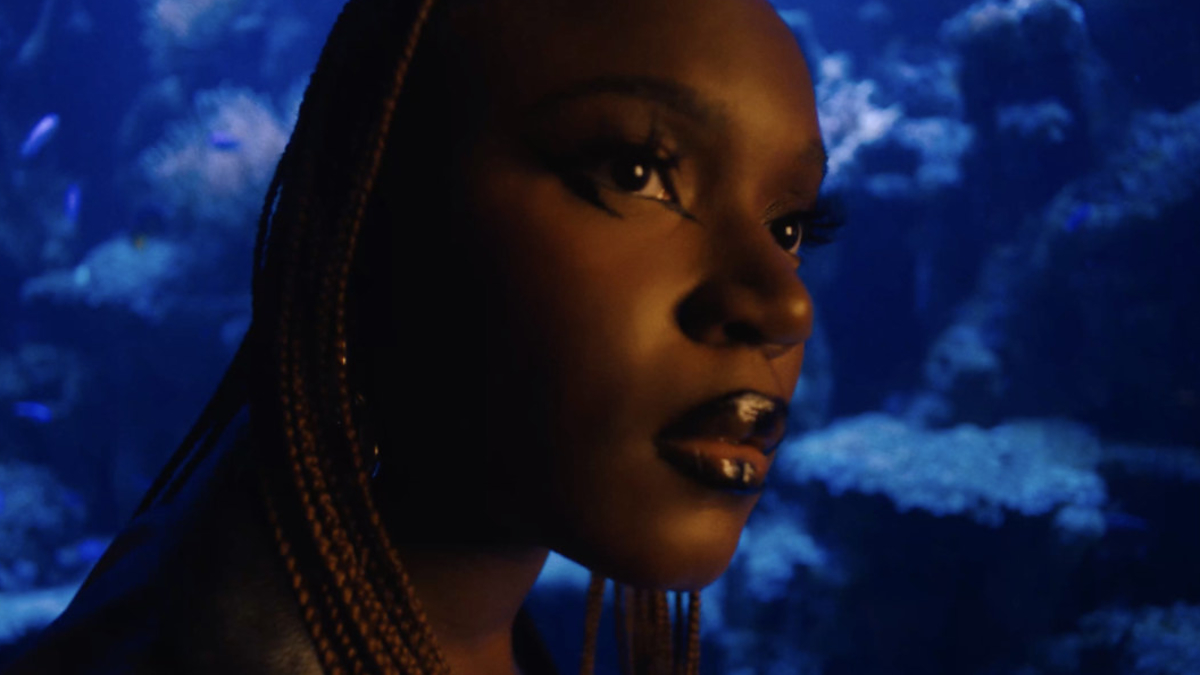
The Ghanaian-American artist Amaarae has emerged as one of contemporary music’s most innovative voices, consistently challenging conventional genre boundaries with her distinctive sound. Her newest album, Black Star, represents both an artistic evolution and a bold statement about creative independence in an industry that often demands categorization.
Born Ama Serwah Genfi, the singer, songwriter, and producer has cultivated a musical style that effortlessly blends elements of Afropop, R&B, alternative rock, and electronic music. This refusal to conform to traditional genre expectations has become a defining characteristic of her work. “The idea of being placed in a box has never made sense to me creatively,” Amaarae explains. “Music is fluid, and I want my art to reflect that same fluidity—the way we actually experience sound in real life.”
Black Star builds upon the foundation laid by her critically acclaimed 2020 debut The Angel You Don’t Know, while venturing into even more experimental territory. The album’s title pays homage to her Ghanaian heritage—the black star being a central symbol in the nation’s flag and identity—while also signaling her celestial ambitions for the project’s reach and impact.
Amaarae describes the album as her most personal work to date, incorporating influences from her childhood in Accra, her adolescence in Atlanta, and her current perspective as a global artist. The recording process spanned multiple continents, with sessions in Ghana, Nigeria, London, and Los Angeles allowing her to collaborate with diverse producers and musicians.
“This record made me explore my own story more profoundly while considering music from an international perspective,” she states. “I aimed to create something that was authentic to my journey but could also connect with audiences from entirely diverse backgrounds.”
The musical compositions in Black Star highlight Amaarae’s development as a producer. Songs transition fluidly between vibrant Afrobeats rhythms, atmospheric alt-R&B vibes, and surprising rock-inspired guitar strings. Her light, androgynous voice glides smoothly over these genre-crossing soundscapes, crafting an auditory experience that appears simultaneously forward-thinking and anchored in heritage.
Amaarae’s unwillingness to fit into predefined categories has sometimes posed difficulties in a sector that depends significantly on genre labels for promotion and airplay. “In the beginning, there were certainly times when executives would ask, ‘This sounds fantastic, but what exactly is it? How should it be classified?'” she reflects. “However, I have always held the view that if the music is compelling enough, it will reach its listeners, no matter the efforts to categorize it.”
This philosophy appears to be proving correct. Despite—or perhaps because of—its genre defiance, Black Star has garnered attention across multiple music scenes. The album’s lead single became an unexpected hit on both Afropop playlists and alternative radio stations, while the accompanying visual aesthetic (a mix of cyberpunk imagery and West African motifs) has sparked conversations in both fashion and contemporary art circles.
Amaarae’s work exemplifies what some critics have called “Afrofuturism 2.0″—art that acknowledges African traditions while imagining bold new possibilities for the continent’s cultural exports. “Growing up between Ghana and the U.S. gave me this dual perspective,” she explains. “I never saw African music as something separate from global pop. It’s all part of one continuum.”
This perspective is evident all over Black Star. One song could include a traditional highlife guitar melody, while another blends in distorted 808s more frequently linked to trap music. The lyrics transition among English, Pidgin, and Twi, capturing the multilingual experience of numerous young Africans today.
Amaarae’s success comes at a moment when African musicians are experiencing remarkable global exposure. Nonetheless, she warns about considering this as a fleeting trend. “What we’re witnessing is not an unexpected revelation of African talent,” she comments. “The foundation has been laid for many years. The distinction now is that we possess greater influence over how our narratives are shared.”
This control is central to Amaarae’s approach. She maintains hands-on involvement in every aspect of her career, from production to visual direction. For Black Star, she assembled a creative team comprised primarily of African women and members of the diaspora, ensuring an authentic representation of her vision.
While Black Star isn’t an overtly political album, Amaarae acknowledges that her very existence as an androgynous, genre-defying African woman in music carries significance. “In some spaces, just being yourself becomes a statement,” she reflects. “I don’t set out to make political art, but I understand that for some listeners, seeing someone like me thrive in this industry does feel revolutionary.”
This undercurrent of quiet rebellion runs through the album’s lyrics, which touch on themes of self-determination, sexual freedom, and the complexities of cultural identity. Amaarae’s songwriting balances these weighty topics with playful wordplay and infectious melodies, creating music that feels simultaneously thought-provoking and effortlessly cool.
With Black Star garnering extensive praise from critics, Amaarae faces a significant turning point. The achievement of the album demonstrates there is a receptive audience for her innovative style, although the music industry is famously averse to artists who challenge straightforward classification.
“I am not concerned about it,” she remarks with her usual confidence. “The world is evolving. Today’s audience can listen to everything simultaneously—they might play an Afrobeats song, follow it with a punk tune, and then something experimental in the electronic genre. My music mirrors that situation.”
In terms of future plans, Amaarae suggests a potential involvement in film scoring and fashion design, although music continues to be her main priority. “Currently, I’m simply savoring this period,” she mentions. “It was a lengthy process to create something that genuinely reflected all my inspirations, and to see people resonating with it is incredible.”
Something appears to be clear: no matter what path Amaarae’s career follows next, it will not be limited by assumptions or genre restrictions. In a time when music is becoming more uniform, her dedication to artistic liberty is both invigorating and essential. Black Star not only signals Amaarae’s emergence as a significant performer but also hints at thrilling opportunities for the future direction of worldwide pop music.
The album acts as both an individual expression and a wide-ranging reflection on the progression of art in today’s digital era. With streaming and social platforms continually dissolving geographical and stylistic boundaries, musicians such as Amaarae—who skillfully integrate elements from the African diaspora and further—might indeed symbolize the direction of mainstream music.
For listeners tired of predictable formulas and eager for something genuinely new, Black Star offers a thrilling glimpse of what happens when an artist fully embraces creative freedom. In Amaarae’s own words: “The boxes were never real anyway. I’m just making the music I hear in my head.”
As the music industry continues evolving, one suspects more artists will follow her lead, creating work that transcends traditional categories in favor of something more fluid, more personal, and ultimately more interesting. In this context, Black Star feels less like an anomaly and more like a sign of things to come—a bright light pointing toward pop music’s boundless future.
